

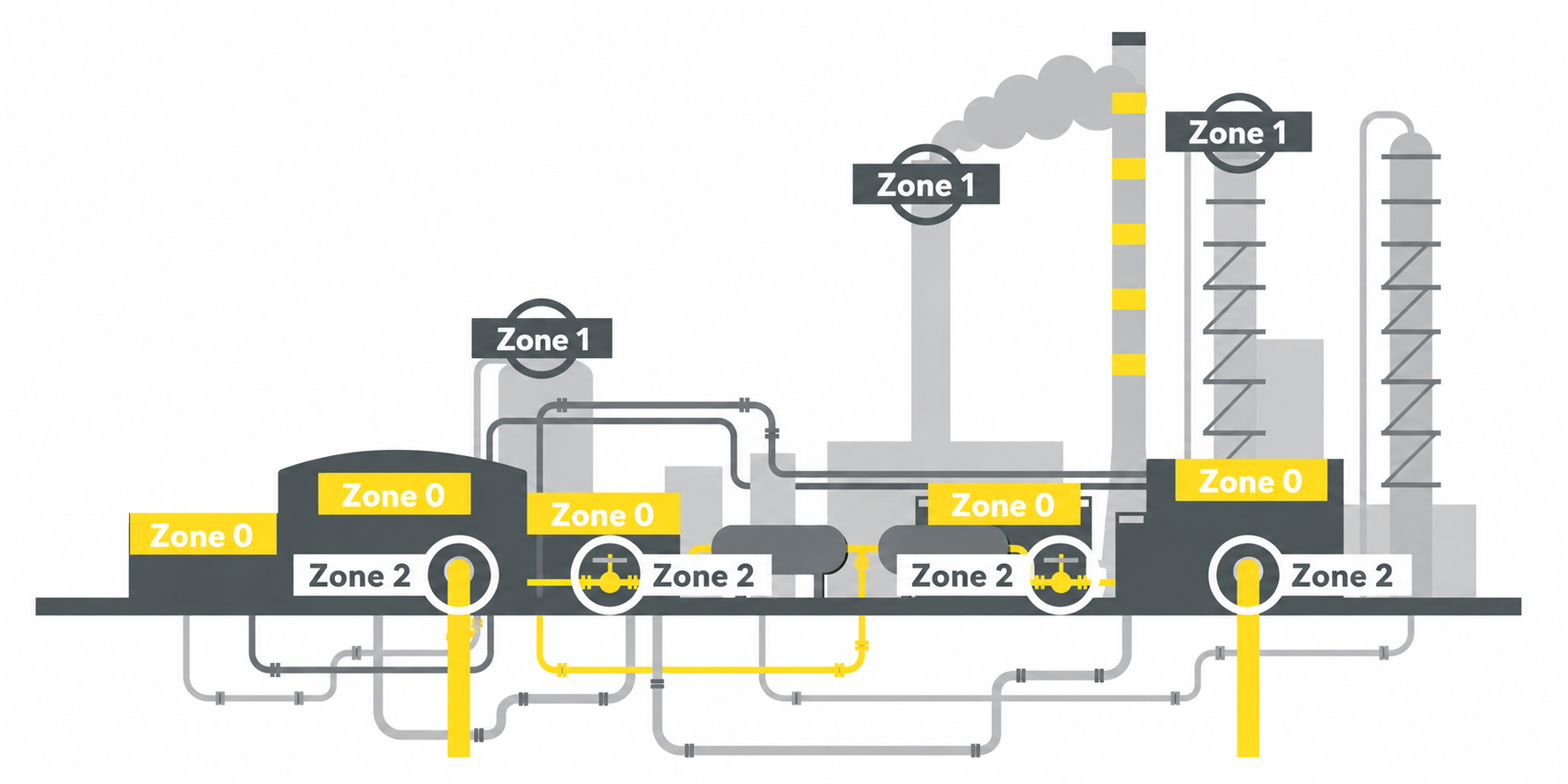
Click on the zone to learn more about the classification according to IEC 60079-10 standards.
Zone 1
An area in which an explosive gas atmosphere is likely to occur in normal operation. In this scenario the space around the tank vents represents a zone 1 because there is likely to be a regular extent of explosive atmosphere in this space
Zone 1
An area in which an explosive gas atmosphere is likely to occur in normal operation. In this scenario the space around the tank vents represents a zone 1 because there is likely to be a regular extent of explosive atmosphere in this space
Zone 1
An area in which an explosive gas atmosphere is likely to occur in normal operation. In this scenario the space around the tank vents represents a zone 1 because there is likely to be a regular extent of explosive atmosphere in this space
Zone 2
An area in which an explosive gas atmosphere is not likely to occur in normal operation and, if it occurs, will only be present for a short period of time. In this scenario the valve flange represents a zone 2 because if the seal fails there could be an explosive atmosphere in this area for a short period of time
Zone 0
An area in which the presence of explosive atmospheres is continuous, frequent or for long time periods. In this scenario the free space in a tank represents a zone 0 because there is likely to be a continuous explosive atmosphere in this space
Zone 0
An area in which the presence of explosive atmospheres is continuous, frequent or for long time periods. In this scenario the free space in a tank represents a zone 0 because there is likely to be a continuous explosive atmosphere in this space
Zone 0
An area in which the presence of explosive atmospheres is continuous, frequent or for long time periods. In this scenario the free space in a tank represents a zone 0 because there is likely to be a continuous explosive atmosphere in this space
Zone 0
An area in which the presence of explosive atmospheres is continuous, frequent or for long time periods. In this scenario the free space in a tank represents a zone 0 because there is likely to be a continuous explosive atmosphere in this space
Zone 0
An area in which the presence of explosive atmospheres is continuous, frequent or for long time periods. In this scenario the free space in a tank represents a zone 0 because there is likely to be a continuous explosive atmosphere in this space